Tree Service In Mountain Home
Healthy Trees, Beautiful Yards, Handled Right Here in Mountain Home
Proudly Serving Boise, Eagle, Meridian, Kuna, Emmett, Star, Nampa, Mountain Home And Surrounding Areas
Mountain Home's High Desert Soil Is Harder on Trees Than Most People Realize
How Elmore County's Rocky, Alkaline Ground Affects Tree Health Over Time
Elmore County sits in a high desert environment, and the ground here tells that story quickly. If you’re looking into tree service in Mountain Home, you should understand your property’s soil conditions before any work begins. The ground around Mountain Home tends to be compacted, rocky, and highly alkaline, which creates real challenges for root systems trying to absorb water and nutrients.
Those conditions gradually stress trees. Roots can’t spread the way they would in looser soil, and alkaline ground blocks the uptake of key minerals. Over time, that stress shows up as thinning canopies, discolored leaves, or branches that die back for no obvious reason.
Why Boise Trusts Us for Tree Care


 Trustindex verifies that the original source of the review is Google.
 Trustindex verifies that the original source of the review is Google.
 Trustindex verifies that the original source of the review is Google.
 Trustindex verifies that the original source of the review is Google.
 Trustindex verifies that the original source of the review is Google.
 Trustindex verifies that the original source of the review is Google.
 Trustindex verifies that the original source of the review is Google.
 Trustindex verifies that the original source of the review is Google.
 Trustindex verifies that the original source of the review is Google.
 Trustindex verifies that the original source of the review is Google.
Ask Us About Our Tree Services
Most Mountain Home Homeowners Don't Need Full Tree Removal
Tree Trimming and Pruning Can Often Do the Job a Removal Would Overkill
A tree that looks rough does not automatically need to come down. That assumption costs many people a perfectly good tree. And more money than necessary.
An ISA Certified Arborist can walk your property and tell you what’s actually going on. A tree showing dead limbs, a thinning canopy, or an awkward lean might be a strong candidate for deadwood removal, crown reduction, or hazard-reduction pruning rather than full removal. Those services address the real problem without losing the tree entirely.
If a branch hangs over your roofline or a back fence, crown thinning or targeted tree pruning is often the right fix. An arborist site inspection looks at the whole picture, not just the most obvious symptom.
Proper tree trimming can restore structure, reduce weight on stressed limbs, and improve long-term tree health. You get a safer yard and a living tree, which is usually the better outcome when removal isn’t actually necessary.
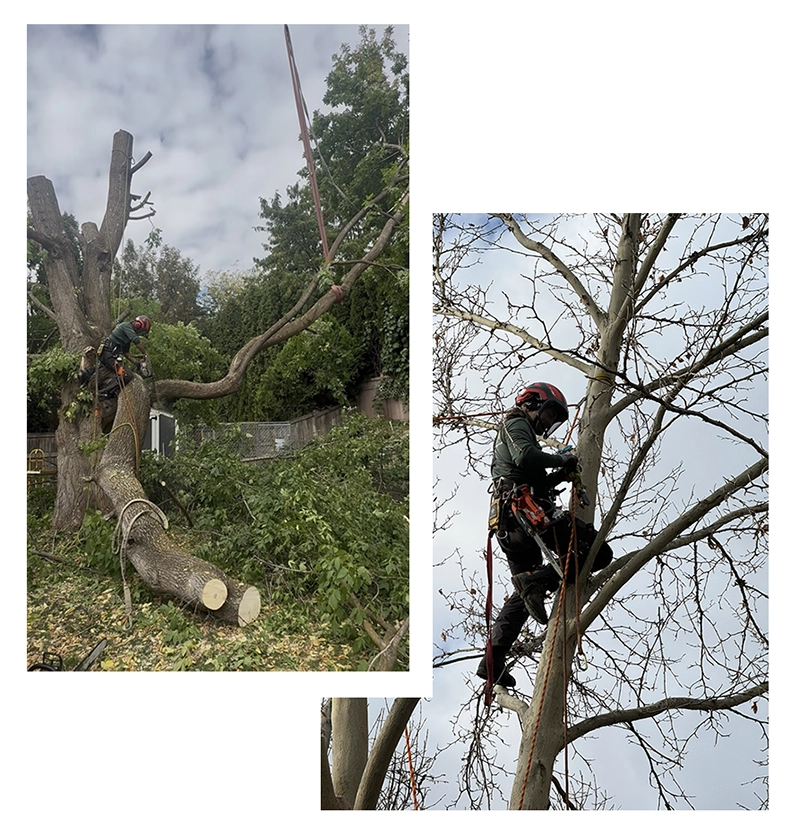
TRAQ Qualification Means Hazard Trees Get a Proper Assessment
TRAQ stands for Tree Risk Assessment Qualification, a recognized arboriculture methodology for evaluating whether a tree poses a genuine hazard. It is not a visual guess. It is a structured process that looks at the tree’s structure, root condition, and failure potential before anyone recommends removal or pruning.
If you have a leaning tree near your fence line or a large limb hanging over your roof, that credential matters. Many residents rent or own property where a wrong call on hazardous tree removal could mean real damage to a structure. A TRAQ-qualified assessment tells you what is actually going on, not just what looks concerning from the driveway.
Licensed and insured residential tree service is the baseline expectation. TRAQ qualification is what separates a tree risk assessment from an educated guess. You get a clear picture of what the tree is doing, the risk level, and your actual options.
A Tree That Looks Fine Today Can Become a Bigger Problem If You Keep Waiting
What Changes in a Tree When Regular Care Gets Put Off
You notice a leaning tree near your fence line and figure it can wait. It is not falling yet, so it stays on the back burner. That is one of the most common situations we hear about, and it is worth understanding what is actually happening inside that tree while you wait.
Tree structural weakness does not appear overnight. It builds gradually as interior wood decays, branch unions weaken, and root systems lose their grip. In Mountain Home’s compacted soil along the US-20 corridor, roots already have a harder time anchoring and drawing nutrients. Deferred seasonal tree maintenance accelerates that process.
Insect and disease management is another area where timing matters. A diseased tree on one side of your yard can spread to healthy trees nearby. By the time the damage is visible, it has usually been spreading for a while.
Tree Removal
Safe efficient removals
Tree Trimming
For beautiful, healthy trees
Emergency Tree Services
Emergency tree services to keep you safe
Arborist Consultation
Professional tree health evaluations
Tree Risk Assessment
Identify hazards and protect property
Specialty Pruning
Improve structure, safety, and tree health
Getting Started With Tree Service in Mountain Home Is Simple
From Your Free Estimate to a Clean Property: What the Full Job Looks Like
Requesting a free estimate is the first step, and it costs you nothing but a few minutes. Once you reach out, an arborist comes to your property for a site inspection. That visit is where you get real answers about what the tree actually needs, whether that’s tree trimming and removal, stump grinding, lot clearing, or something less involved.
After the inspection, you receive a transparent quote. Tree removal cost is something a lot of people worry about going in, so the goal is to make sure you understand what you’re paying for before any work begins. No surprises.
On service day, the crew handles the full job. Cutting, debris removal, and stump removal are all part of the process. When the crew leaves, your yard looks clean. That’s the concrete outcome you should expect.
If you’re in Mountain Home or anywhere in Elmore County and you’re not sure whether your tree situation is urgent, reaching out for an estimate is a low-pressure way to find out. You get information, not a sales pitch.
ISA-Certified Arborists On Staff (PN-9369A)