Emergency Tree Services In Meridian
Fast Emergency Tree Service When You Need It Most in Meridian
Proudly Serving Boise, Eagle, Meridian, Kuna, Emmett, Star, Nampa, Mountain Home And Surrounding Areas
Meridian's Storm Conditions Create Tree Hazards Homeowners Don't See Coming
How Local Soil and Wind Events Turn Healthy-Looking Trees Into Fallen Trees
Meridian’s soil holds water long after a rainstorm passes. When the soil becomes saturated, it loosens its grip on root systems, and trees that looked perfectly stable can shift, lean, or be uprooted with little warning. If you live near Settler’s Park or along the Linder Road corridor, you’re surrounded by mature trees with decades of growth above ground and potentially compromised root depth below it. That combination is exactly why Emergency Tree Services in Meridian gets searched so often after a storm.
Alkaline soil limits how deep and wide roots can spread. Roots in tight clay tend to stay shallow, which means the tree’s foundation is narrower than it looks from the street. When high winds hit a full canopy on top of a shallow root system, you get uprooted trees and emergency storm damage that catches people off guard.
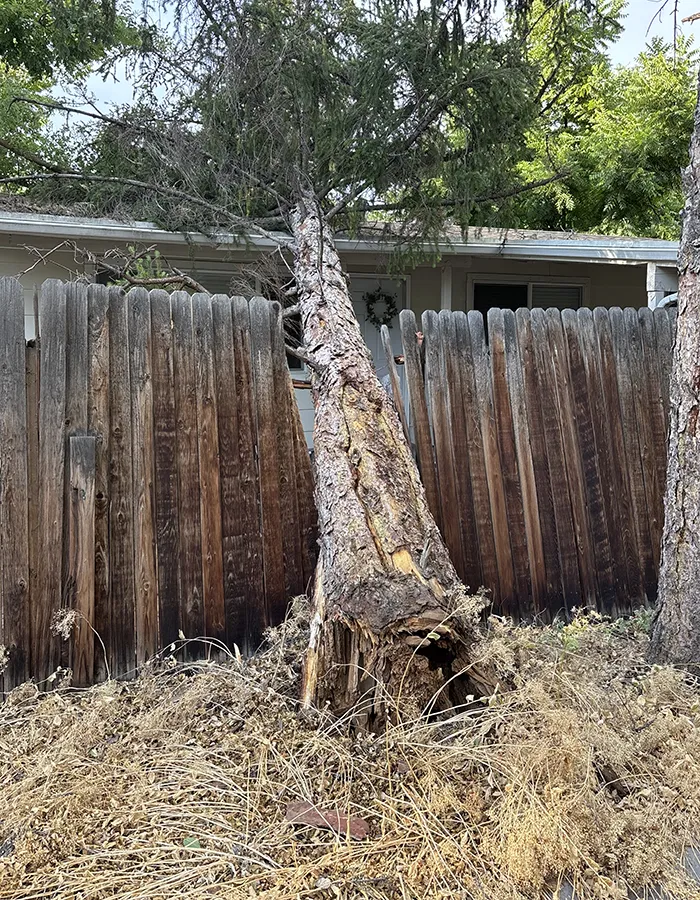
The Ten Mile Road corridor has a different but related problem. Younger landscaped trees planted during rapid residential development don’t have established root systems yet. Wind throw is common there, and a fallen tree or a hazardous tree leaning toward a fence line or structure needs fast attention.
Call For Fast Emergency Tree Service
What Actually Happens When We Respond To An Emergency Call in Meridian
From Your First Call to Debris Hauling. Here Is the Full Sequence
When you call, a real person picks up. You describe what you’re dealing with; we ask a few quick questions about the tree’s size, location, and what it’s touching, and we confirm same-day availability if the situation calls for it.
Once the crew arrives, we conduct a formal tree risk assessment. This isn’t a quick glance. It’s a structured evaluation of the tree’s position, structural condition, and what’s directly in the failure zone, whether that’s your roof, a fence, or a driveway.
From there, we direct the removal plan. Emergency tree removal standards mean the rigging, cut sequencing, and lowering techniques are deliberate, not improvised. That matters when a leaning tree hangs over a structure near a dense neighborhood.
The crew handles the full removal, then moves into hauling the tree debris. Everything comes off your property. If you want stump grinding done during the same visit, we can handle that too, so you’re not left coordinating a second contractor later.
If follow-up pruning is needed on adjacent trees after the emergency is resolved, the same company can handle it. One call, start to finish.
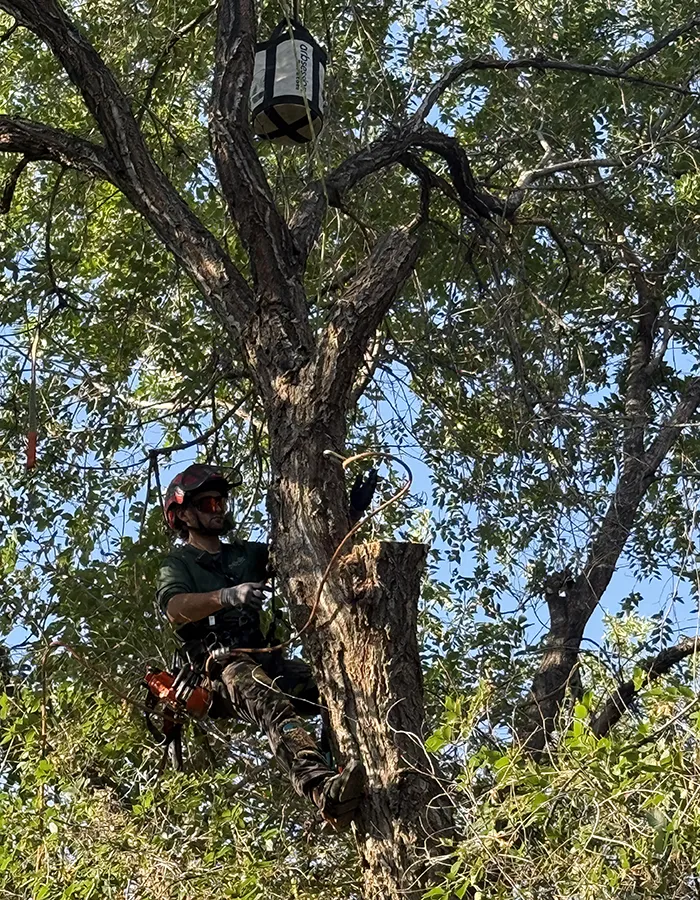
Here Is What Credentials Actually Do for You After a Storm
An ISA Certified Arborist carries more than a title. That credential requires passing a rigorous exam covering tree biology, risk assessment, and structural failure. In a storm, that knowledge separates a qualified evaluation from a guess.
TRAQ qualification goes one step further. A TRAQ-qualified professional follows a standardized tree risk assessment method that produces a written, documented report. If your insurance adjuster needs proof of a hazardous condition, or your HOA requires documentation before approving removal, that report moves the process forward.
If you called an unlicensed crew, they can cut. They cannot tell you which trees actually need to come down and which are structurally sound. That difference matters when you decide whether to spend money on removal.
Where younger landscaped trees went in fast during rapid development, a tree health assessment often reveals that a leaning tree is stressed but not failing. Removing it unnecessarily costs you money you did not need to spend.
Licensed and insured means liability insurance and workers’ compensation are both in place. If something goes wrong on your property during the job, you won’t be left holding the exposure. A free estimate gets you a clear scope before any work begins.
Waiting on a Damaged Tree Changes What Options You Have Left
What a Certified Arborist Can Still Do, and What Becomes Harder the Longer You Wait
Most people assume a damaged tree is either fine or it needs to come down. That’s not usually how it works.
Structural problems like included bark, deadwood accumulation, or uneven crown weight can often be managed with tree cabling and bracing or structural pruning, but only if the tree hasn’t failed further. Once a branch tears or a union cracks under load, those options close. What was a cabling job becomes a removal.
Fallen limbs blocking a driveway feel urgent in a different way than a slow lean, but both narrow your choices over time. A tree leaning toward a structure or sitting over power lines needs evaluation sooner because access gets harder as conditions change. Crews working near power lines face different constraints than those with open clearance, and the equipment required often changes too.
Many of the trees in that area are younger with shallower root systems, which makes structural pruning and crown thinning realistic options when problems are caught early. Deadwood removal and canopy work can extend a tree’s life considerably when there’s still something worth saving.
A tree on a structure is a different situation entirely. That’s not a wait-and-see scenario. But a leaning tree that hasn’t failed yet? You still have options worth knowing about.
Tree Removal
Safe efficient removals
Tree Trimming
For beautiful, healthy trees
Emergency Tree Services
Emergency tree services to keep you safe
Arborist Consultation
Professional tree health evaluations
Tree Risk Assessment
Identify hazards and protect property
Specialty Pruning
Improve structure, safety, and tree health
Getting Help From On The Block Is Straightforward. Here Is Where to Start
Request a Free Estimate and Get a Documented Assessment You Can Use Right Away
Picture this: it is 10 p.m., a tree is down on your fence, and you have no idea who to call or whether your insurance will cover any of it. That’s exactly why 24/7 emergency response exists. You reach out, describe what you are dealing with, and we get eyes on it fast.
The free estimate includes a written assessment you can hand directly to your insurance adjuster or HOA. If you are in a newer neighborhood dealing with a wind-thrown tree, that documentation can matter a lot when you are sorting out tree removal costs with your provider.
If you are not in an urgent situation right now, you can still schedule a morning appointment and get the same thorough evaluation. Residential and commercial properties both qualify. We handle emergency tree service and planned storm cleanup the same way, with the same crew.
Once the immediate work is done, the same company can handle stump removal and lot clearing. You do not have to find someone else to finish the job. One call covers the tree, the stump, and the debris.
Request your free estimate and let a TRAQ-qualified arborist document exactly what you are dealing with. That report is yours to keep and use however you need it.
ISA-Certified Arborists On Staff (PN-9369A)